
NEWS
Blizzard Workers Ratify Historic Union Contract Covering 1,900 Employees
The landmark agreement establishes binding wage minimums, generative AI bargaining requirements, expanded severance, and recall protections ahead of BlizzCon.
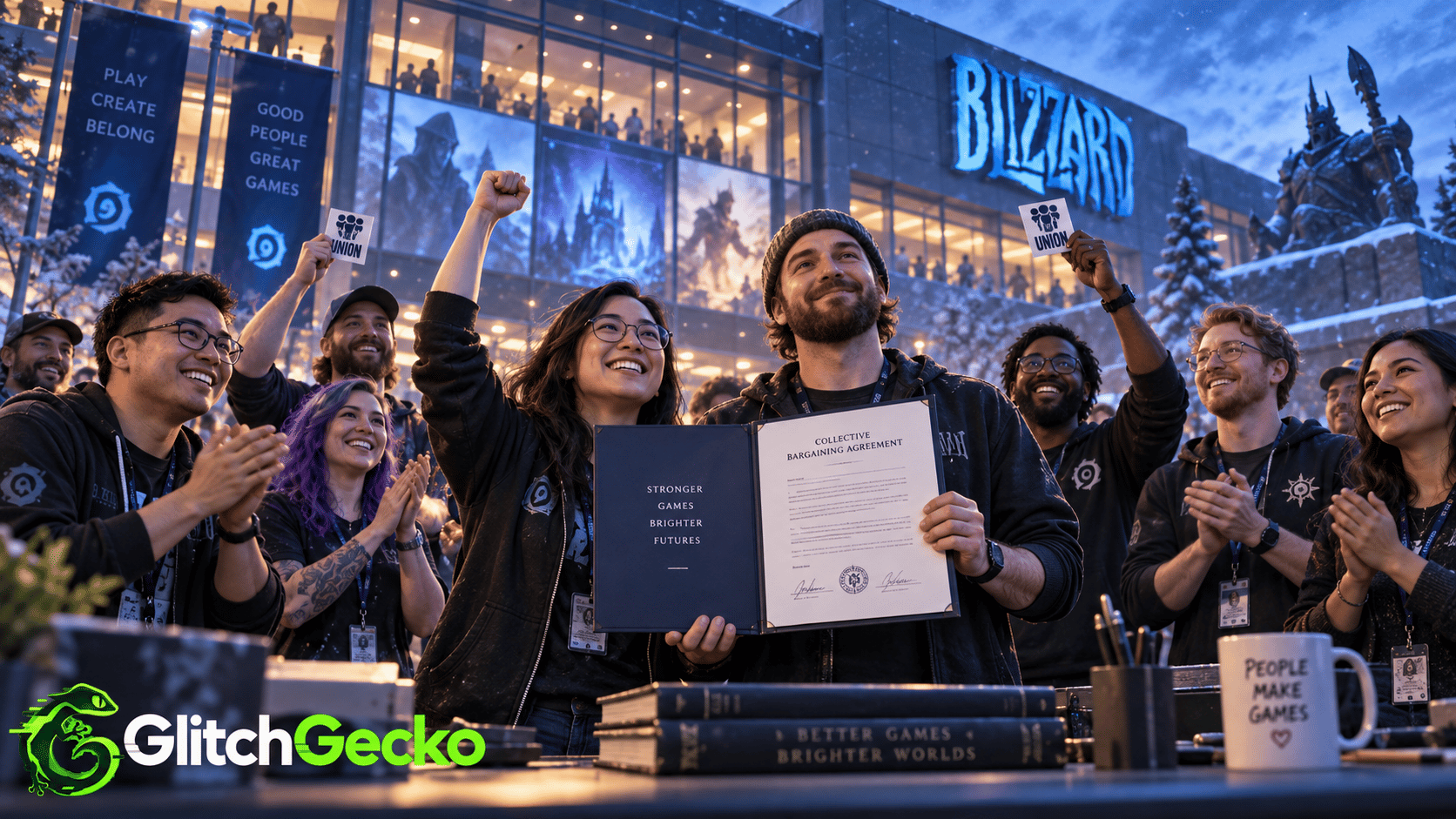
A Landmark Ratification Across Major Franchises
Nearly 1,900 union-represented workers across Blizzard Entertainment have voted to ratify historic collective bargaining agreements with the Communications Workers of America (CWA). The deal marks the largest union contract ratification in the history of the North American video game industry.
The scope of the ratified agreement spans core development teams across Blizzard's flagship franchises, including World of Warcraft, Overwatch, and Diablo. Coverage also encompasses critical supporting infrastructure, including quality assurance testers, IT personnel, and shared central technology teams.
Rather than fragmenting future negotiations across dozens of individual studio disciplines, the agreement consolidates Blizzard's organized workforce into three primary bargaining units. These groups now operate under unified master contract terms, giving disparate development and support teams a synchronized collective voice during workplace bargaining.
Enforceable Wage Floors and Expanded Layoff Protections
At the center of the economic settlement are newly established, enforceable base salary minimums alongside scheduled pay increases across all covered job classifications. These standards directly address long-standing pay disparities in game production by setting binding compensation floors for lower-earning staff, such as entry-level quality assurance testers who historically faced sub-$50,000 compensation, while ensuring guaranteed wage growth trajectories for veteran developers across engineering, art, and design.
By replacing discretionary studio raises with contractual, scheduled pay adjustments, the agreement eliminates arbitrary compensation freezes and establishes predictable earnings progression across the workforce.
While the contract does not immunize staff against broader corporate restructurings, it builds substantial safety nets in the event of workforce reductions. Covered employees who face layoffs will receive four additional weeks of severance pay beyond standard corporate packages, cushioning the financial blow of industry volatility.
The deal also institutes a formal 14-month recall window. Under these terms, laid-off union workers retain preferential rights to apply for open positions across any Blizzard bargaining unit, keeping institutional knowledge within the studio rather than forcing displaced developers out of the company ecosystem.
Generative AI Guardrails and Workplace Standards
Addressing one of the most contentious debates in modern game development, the contract establishes explicit workplace guardrails surrounding artificial intelligence. Management is contractually required to negotiate with union representatives prior to introducing or deploying generative AI tools into covered production pipelines, ensuring staff have oversight rather than facing unilateral implementation.
The agreement also codifies everyday workplace expectations. It establishes a structured three-day in-office hybrid schedule as a transparent baseline while preserving protected remote work arrangements, and implements standardized developer crediting rules to ensure staff receive formal public credit on shipped titles.
From 2022 Organizing to Pre-BlizzCon Precedent
This successful ratification resolves more than two years of active labor negotiations across Activision Blizzard and Microsoft. The organizing drive began in earnest with quality assurance workers in 2022 before expanding to hundreds of World of Warcraft developers in early 2024, ultimately building the multi-department coalition that secured the current terms.
Finalized just days ahead of Blizzard's BlizzCon convention in Anaheim, California, the contract provides operational stability heading into the studio's premier community showcase. More broadly, it establishes an influential labor benchmark across Microsoft's gaming division and sets a concrete blueprint for union contracts throughout the wider AAA video game sector.
Sources
- Blizzard Entertainment Workers Ratify Historic Video Game Contracts with CWA | Communications Workers of America — Communications Workers of America · https://cwa-union.org/news/releases/blizzard-entertainment-workers-ratify-historic-video-game-contracts-cwa
- Blizzard union workers ratify historic contract covering 1,900 employees - Game Developer — Game Developer · https://gamedeveloper.com/production/blizzard-union-workers-ratify-historic-contract-covering-1-900-employees
- Blizzard Workers Ratify Union Contract With Microsoft - Kotaku — Kotaku · https://kotaku.com/blizzard-workers-union-contract-microsoft-2000732422
- Blizzard video game workers ratify union contract - Los Angeles Times — Los Angeles Times · https://latimes.com/entertainment-arts/business/story/2026-09-09/blizzard-video-game-workers-ratify-union-contract
- After Years Of Company Stalling, Blizzard Workers Win Mega-Contract That Applies To All Unionized Teams — Aftermath · https://aftermath.site/blizzard-union-contract-warcraft-overwatch-diablo
- Blizzard Workers Secure Historic Contract Covering AI Use & Layoff Protections - 80 Level — 80 Level · https://80.lv/articles/blizzard-workers-secure-historic-contract-covering-ai-use-layoff-protections
- Blizzard Workers Win Historic Union Contract That Could Set A New Standard For Game Developers - GameSpot — GameSpot · https://gamespot.com/articles/blizzard-workers-win-historic-union-contract-that-could-set-a-new-standard-for-game-developers
- Microsoft has agreed to new labor guarantees for 1900 Blizzard specialists. — GameGPU · https://en.gamegpu.com/news/igry/kompaniya-microsoft-soglasovala-novye-trudovye-garantii-dlya-1900-spetsialistov-blizzard